

I’ve always loved reading fiction. Mysteries, thrillers, adventures. The kind of stories that pull you in and don’t let go. For a long time, I assumed I would eventually write a novel. Maybe try to get it published, or at least self-published.
Then a conversation changed everything.
It was Christmas Eve. The family was gathered around, chatting, though one of my older relatives watched the phone-scrollers around her with quiet disapproval. She mentioned, almost in passing, how much she missed getting letters in the mail and that all this texting was nonsense. Honestly, in the moment it didn’t fully land. But for some reason, it stuck with me.
Over the coming months, I kept thinking about that comment. I’ve always loved epistolary fiction (stories told through letters) and had thought about writing a novel in that genre. Then it hit me: what if the letters weren’t in a book at all? What if they were real, physical letters, arriving in your mailbox one at a time? Fiction Mail was born.
Building It From Scratch
The first series I wrote was Seeking Justice, a mystery that follows an amateur detective named Jen investigating what she believes is a murder the police had written off too quickly. I had a vague idea of what I wanted to create, but a lot was still unknown. How long should the series be? How would I print the letters? Would anyone even want this?
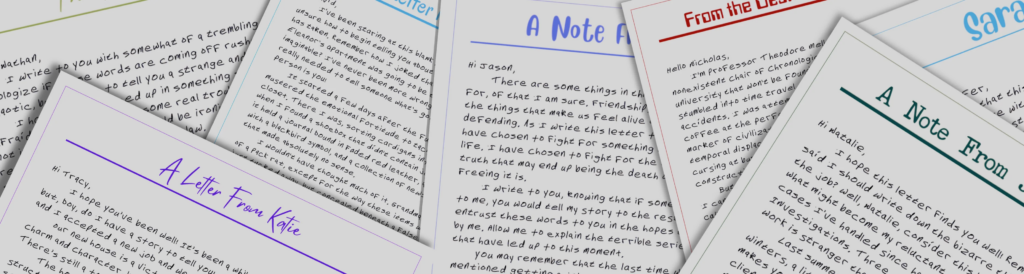
As I wrote, the story naturally evolved into eight letters. Then came the question of how they should look. I wanted them to feel handwritten, like a real letter from a friend. But each letter runs about six pages, and hand-writing 48 pages per copy wasn’t going to work.
So I researched handwriting fonts. The generic ones looked exactly like that: generic. Then I found software that converts your own handwriting into a custom font. The process involves printing out templates that include every letter, number, and symbol, filling them out by hand four times each, scanning them, and letting the software build a font from your actual handwriting. The result has four variations of every character, so there are real variations of the characters on the page, just like real handwriting. It was exactly what Fiction Mail needed.
For personalization, each letter naturally uses the recipient’s name throughout, not just in the salutation, the way you’d mention a friend’s name when writing to them. So it genuinely feels like a personal letter from a friend, a fictional one, but a friend nonetheless.
My Writing Life
I write at my desk in a Leuchtturm1917 notebook. I’m a firm believer in keeping paper and pen within arm’s reach. Ideas don’t wait for you to open a new tab on a browser.
On the go, I carry a Pilot Precise V5. It’s affordable, which matters since I lose pens at an impressive rate. At my desk, I write with a Lamy Safari, which feels like a small luxury that makes the work feel intentional.
What Fiction Mail Means to People
Many customers and recipients leave reviews or email me about what a unique experience Fiction Mail is, how much fun it was, and how much joy the thrill of getting letters brought them. But one story surprised me more than any other.
Laurie gifted the Cold War Spy series to her 15-year-old daughter. The series contains letters from Eliza, who discovers, while cleaning out her late grandmother’s apartment, that her sweet, cookie-baking grandma was actually a brilliant Cold War spy. Laurie left a review that made me smile: “This was for my 15-year-old daughter… The story inspired my daughter to start digging into my great grandmother’s history.”
That’s what Fiction Mail can do. It doesn’t just entertain. It can spark something.
What a Letter Does That a Screen Can’t
We spend our days staring at screens. Even leisure reading often happens on a device. I’m all for people reading however they want, as long as they experience the joy of it. But there’s something uniquely powerful nowadays about opening your mailbox and finding a letter waiting for you.
When you get a letter in the mail it’s probably mixed in with coupons and catalogs. And it’s likely been a very long time since you last received a real letter, or, if you’re younger, maybe you never have. When you open the envelope, fish out the letter, unfold it, and see your name at the top, it’s a little magical.
And when the letter ends with a promise that another one is coming next week, you have something real to look forward to. You can’t skip ahead. You can’t binge it. The next part of the story arrives when it arrives, in your mailbox.
That’s what Fiction Mail is really about. It’s not just fiction. It’s anticipation, nostalgia, and story all rolled into one.
If you’re curious, you can explore all the series at fictionmail.com.
Subscribe to the LetterMo email newsletter today!